

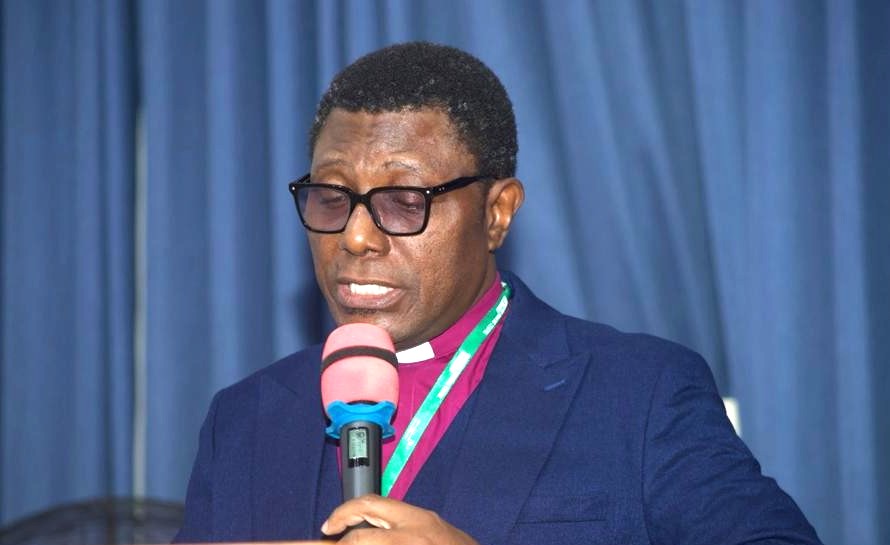

The Guest Speaker at the 22nd National Evangelism and Church Growth Consultation, Rev. Gideon Buernor Puplampu, has challenged church leaders and members to refocus their Christian witness on discipleship rather than the pursuit of material prosperity.
Addressing participants at the consultation underway at the Ramseyer Training Centre, Abetifi, the Dangme-Tongu Presbytery Chairperson, warned that many Christians are increasingly defining the quality of their faith and church life by material possessions, contrary to the biblical model of discipleship.
The five-day consultation, under the theme, “Celebrating Our Heritage: Building on the Foundation Already Laid – Nurturing Christ-Centred Disciples” (1 Corinthians 3:10-11; Matthew 16:24-26), is being held from November 9 to 13, 2026, and has brought together Presbytery Chairpersons, Presbytery Clerks and Directors of Mission and Evangelism.
Also in attendance are the Moderator of the General Assembly, Rt. Rev. Dr. Abraham Nana Opare Kwakye, the Clerk of the General Assembly, Rev. David Aboagye Danquah, and representatives of various groups and ministries within the Church.
Speaking on the theme of raising Christ-centred disciple-makers, Rev. Puplampu identified three key characteristics of true disciples: surrender, obedience and an understanding that life in Christ transcends material benefits.
“To become a disciple: first, surrender. Second, obedience. The third would be a discipline that life in Christ is beyond material benefits,” he stated. Rev. Puplampu observed that contemporary Christianity is increasingly measured by material success rather than spiritual growth and commitment to God’s mission.
“Life in Christ is beyond material benefits. We live in a day when the excellence of the Christian life and the church is defined by the abundance of material benefits,” he observed.
With lessons from the biblical account of Peter, James and John, Rev. Puplampu noted that although Christ blessed them with an abundant catch of fish after they obeyed Him, they ultimately left everything behind to follow Him.
He argued that while material resources are necessary for ministry, they should never become the primary goal of Christian life and service. “Yes, we need the buildings. We need the vehicles. We need the money. We need all the gadgets. We need all of them. But to what end?” he asked.
He stressed that God provides material blessings not as an end in themselves but as tools for advancing His kingdom and drawing others into a relationship with Christ. He expressed confidence that God would continue to supply the needs of believers and congregations that remain committed to discipleship.
“I want to believe that the Lord will continue to supply the material needs in abundance if we commit to the prime purpose of connecting to Him and using all we have for the purpose of drawing others to Him,” he said. Rev. Puplampu further cautioned that the Church risked losing its focus when material gains overshadowed spiritual formation and disciple-making.
“We are falling into the tendency of pursuing the material benefits at the expense of discipleship,” he said. “While I believe that material things are necessary, I want to insist that in anyone who gets busy in the business of discipleship, God will not neglect them.”
He encouraged participants to invest intentionally in discipling children, youth, men’s and women’s fellowships, and ministers’ families, assuring them that God would provide the resources needed for the task.
Rev. Puplampu also challenged ministers and church leaders to model the spirit of surrender that they seek to cultivate in others. Reflecting on the resistance often encountered when introducing disciple-making initiatives in congregations, he questioned whether members and leaders alike had fully learnt to yield their preferences and programmes to God’s purposes.
He urged participants to prioritise the formation of faithful disciples who are surrendered to Christ, obedient to His Word and committed to eternal values rather than temporal gains.
“The first three things I think we can do to help our Church are to raise people who surrender, people who obey, and people who know that material benefits are not the end,” he concluded. “The Lord will continue to teach us how to generate material benefits, that we might use them appropriately to the glory of God.”
By Jerome Otchere
