

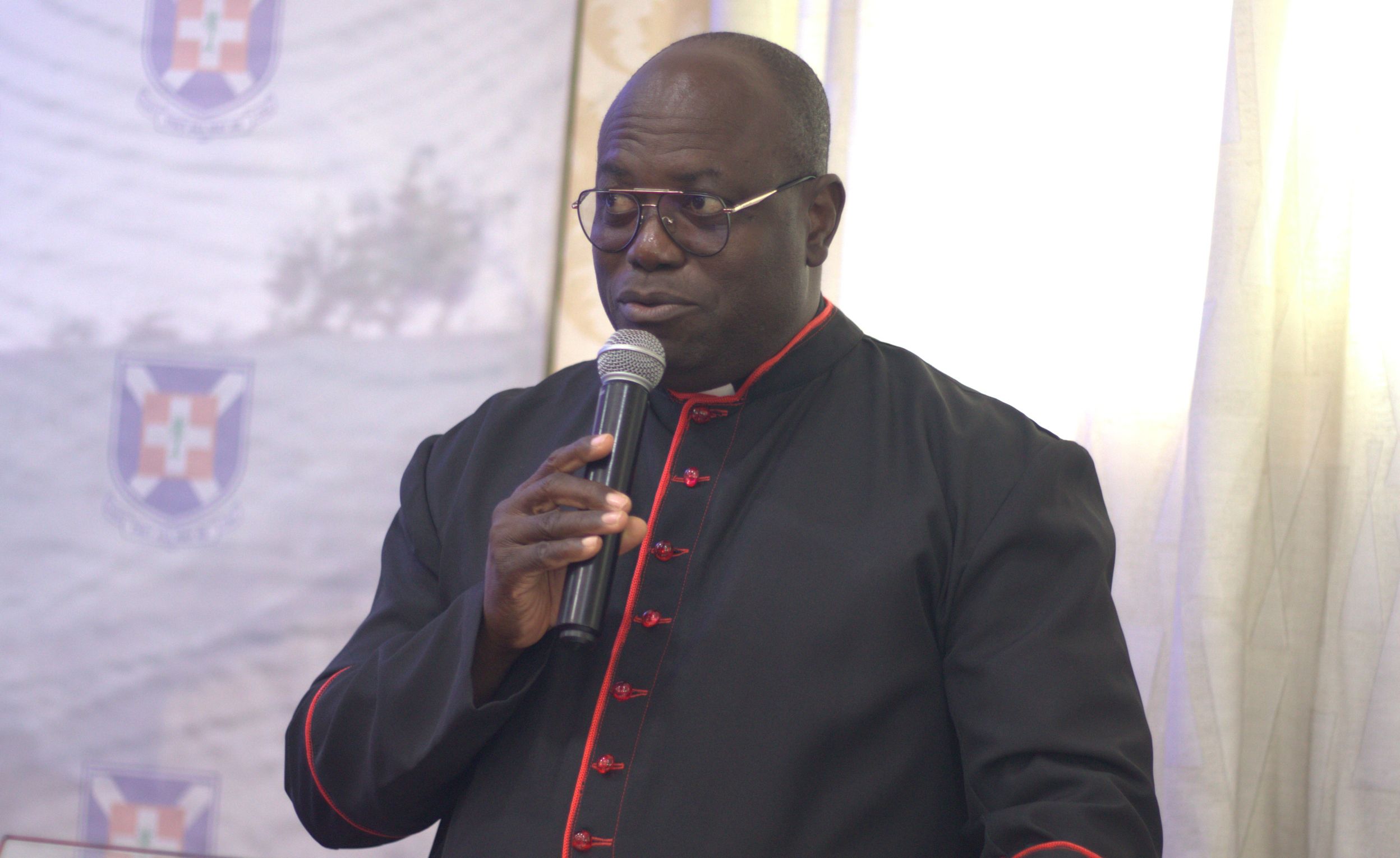

Over the past year, one of the privileges of serving as the Public Relations Officer of the Presbyterian Church of Ghana has been the opportunity to report on the public speeches and sermons of the Moderator of the General Assembly, Rt. Rev. Dr. Abraham Nana Opare Kwakye.
From induction and anniversary services to pastoral visits and major church programmes, a pattern has emerged from the Moderator’s public addresses that deserves closer attention. I penned this article as I revisited notes on my phone and reflected on the numerous occasions, I have listened to the Moderator speak and written on his sermons since assuming this role.
His sermons are more than occasional homilies crafted to fit particular events. They reveal a coherent theological outlook, a disciplined Christian ethic, and a deep concern for the spiritual and moral formation of both the Church and society.
This is not an attempt to eulogise the Moderator. Rather, it is a candid observation from someone who has had the privilege of listening closely, plotting storylines, reporting, and attempting to understand the ideas that consistently shape his public speeches.
What stands out first is his unwavering Christ-centredness. Whether speaking on church unity, leadership or governance, the Moderator invariably returns to the centrality of Christ. He repeatedly reminds congregants that Christ must remain the reason for our gathering and that whenever anything else takes His place, division inevitably follows.
That emphasis is not accidental. It reflects a theology that views the Church not as an institution existing for its own sake, but as one gathered around the person, work, and mission of Jesus Christ. As a ministerial student, I find this both instructive and refreshing: Christ is everything.
A second feature is the Moderator’s concern for spiritual authenticity. During his pastoral visit to the Ga West Presbytery earlier this year, he challenged what he described as lifeless formalism in worship, declaring that “Presbyterians are not God’s chosen frozen.” The statement was provocative for my curious mind.
The Moderator argued that genuine worship is neither about location nor tradition alone. Rather, it is an encounter with God in spirit and in truth. That sermon was revealing. It showed the posture of a church leader who is deeply rooted in Presbyterian tradition, yet unwilling to allow tradition to become a substitute for spiritual vitality.
The Moderator’s theology is unmistakably Reformed, yet not rigid; doctrinally grounded, yet spiritually whole. I love that. Another recurring theme is discipline. Indeed, if I were to identify the dominant thread in many of his sermons, it would be the call to disciplined Christian living.
Repeatedly, the Moderator has warned against disorderliness, indiscipline and behaviours that weaken congregational life. As recently as the induction of the Chairperson of the Central Presbytery, he cautioned ministers and church leaders against flattery and manipulation, urging them instead to cultivate discernment and remain faithful to God.
The Moderator’s concern for discipline extends beyond the Church. When addressing matters of national leadership, he consistently challenges politicians to model truthfulness, integrity, and faithfulness. At the Martyrs’ Day remembrance service and on other occasions, he has argued that God’s faithfulness provides the ethical standard by which believers in public office ought to conduct themselves.
His concern for discipline is profoundly Presbyterian. It reflects the conviction that discipleship must shape character and conduct. Equally striking is the Moderator’s ability to connect biblical texts with contemporary realities. He moves from Scripture to practical application with remarkable ease, yet without forcing the connection.
One practice I have noticed repeatedly is his methodical approach to interpretation. After reading the biblical text, he often pauses briefly and then says, “And now the context.” That simple phrase reveals much about his preaching. It signals a deliberate effort to bridge ancient Biblical text and the present reality of the congregation before him.
I do not have the theological weight and authority to evaluate his sermons. Yet as an observer, I find that contextual perspective admirable. It is done carefully, thoughtfully, and purposefully.
When preaching on Matthew 22:15-22 at Agona Nsaba recently, he connected Jesus’ encounter with the Pharisees to contemporary leadership challenges. When speaking about God’s faithfulness, he applied the concept not only to personal spirituality but also to political responsibility and public ethics.
As someone who enjoys reading scholars, I cannot help but notice the influence of a lifelong student of Scripture. In the Moderator, one encounters a preacher who has spent years studying, teaching, and reflecting on the biblical text. His arguments are structured, his reasoning is clear and his conclusions remain firmly anchored in Scripture.
The result is that his preaching often feels like a classroom of discipleship where doctrine and ethics intersect. For the PCG, this has important implications. In an age marked by theological confusion, the PCG must remain focused on what matters most: Christ, Scripture, faithfulness, disciplined discipleship, and moral integrity.
For me as a ministerial student, the Moderator reinforces the importance of preparation, theological depth, and consistency. Effective ministry is not the ability to speak eloquently. It requires disciplined study, careful exegesis, intellectual curiosity, and spiritual maturity. Preaching must flow from a life shaped by godliness and not merely scholarship.
As a journalist and now a public relations practitioner, I have also learned that sermons are often more than news events. They provide a window into the theological convictions that shape a leader’s ministry and, by extension, influence the direction of the Church.
Under the leadership of Rt. Rev. Dr. Abraham Nana Opare Kwakye, the PCG is on the right path. The more I listen to him, analyse his messages and craft stories for publication, the more convinced I become that this is not merely rhetoric. It is speech reinforced by action, conviction supported by character.
In an era of social media noise, instant opinions and shallow spirituality, there is value in preaching that rejects cheap popularity and continually points people back to Christ. That is what the Moderator does. It is the strongest lesson I have drawn from his public addresses. He is a man who consistently seeks to direct attention away from himself and back to Christ. That is encouraging and that is what it must be for every minister.
By Jerome Otchere
